 Hmmm.
Hmmm. I'm open to harm reduction, but I'm troubled by the culture of many harm reductionists.
Half of patients do not respond when they are given the medications, which can be powerful tool in helping the depressed to feel better. Instead of raising levels of a "happiness chemical", called serotonin, in their brain, they lower them.The researchers found with some brain cells "the more antidepressants try to increase serotonin production, the less serotonin (they) actually produce,” said Dr Rene Hen, from Columbia University in New York and a researcher at the New York State Psychiatric Institute, who led the study.
Among the work group’s proposals is the recommendation that the diagnostic category include both substance use disorders and non-substance addictions. Gambling disorder has been moved into this category and there are other addiction-like behavioral disorders such as “Internet addiction” that will be considered as potential additions to this category as research data accumulate.
Dutch teens who were allowed to drink alcohol at home drank more outside the home than their peers and -- along with other teens who drank -- were at increased risk of developing alcohol problems, according to researchers from Radboud University Nijmegen.The study authors tracked 428 Dutch families with two children ages 13-15. They found that teens who drank at home also drank more on their own, and vice-versa, suggesting that teen drinking begets more teen drinking regardless of setting.
"The idea is generally based on common sense," said researcher Haske van der Vorst. "For example, the thinking is that if parents show good behavior -- here, modest drinking -- then the child will copy it. Another assumption is that parents can control their child's drinking by drinking with the child."
However, the study demonstrated that, "If parents want to reduce the risk that their child will become a heavy drinker or problem drinker in adolescence, they should try to postpone the age at which their child starts drinking," said van der Vorst.
The research was published in the January 2010 issue of theJournal of Studies on Alcohol and Drugs.
ABSTRACT
Rationale Indices of negative affect, such as depression, have been implicated in stress-induced pathways to alcohol relapse. Empirically supported continuing care resources, such as Alcoholics Anonymous (AA), emphasize reducing negative affect to reduce relapse risk, but little research has been conducted to examine putative affective mechanisms of AA's effects.
Methods Using lagged, controlled, hierarchical linear modeling and mediational analyses this study investigated whether AA participation mobilized changes in depression symptoms and whether such changes explained subsequent reductions in alcohol use. Alcohol-dependent adults (n = 1706), receiving treatment as part of a clinical trial, were assessed at intake, 3, 6, 9, 12 and 15 months.
Results Findings revealed elevated levels of depression compared to the general population, which decreased during treatment and then remained stable over follow-up. Greater AA attendance was associated with better subsequent alcohol use outcomes and decreased depression. Greater depression was associated with heavier and more frequent drinking. Lagged mediation analyses revealed that the effects of AA on alcohol use was mediated partially by reductions in depression symptoms. However, this salutary effect on depression itself appeared to be explained by AA's proximal effect on reducing concurrent drinking.
Conclusions AA attendance was associated both concurrently and predictively with improved alcohol outcomes. Although AA attendance was associated additionally with subsequent improvements in depression, it did not predict such improvements over and above concurrent alcohol use. AA appears to lead both to improvements in alcohol use and psychological and emotional wellbeing which, in turn, may reinforce further abstinence and recovery-related change.
The study, which appeared in the Archives of General Psychiatry, demonstrated that the TA-CD vaccine could blunt the effects of cocaine in some, but not all, patients. The vaccine works by causing the production of antibodies, which attach themselves to cocaine molecules, making the molecules too big too pass effectively through the blood-brain barrier.Of 115 addicts involved in the study, only 38 % produced sufficient antibodies to dull the effects of cocaine, Rachel Saslow of theWashington Post reported. And among the high-antibodies group, only 53 % stayed free of cocaine 50 % of the time. “Immunization did not achieve complete abstinence from cocaine use,” said Thomas Kosten of Baylor college of Medicine, one of the authors of the paper.Moreover, in some of the study participants for whom antibodies made cocaine a disappointing high, researchers found cocaine levels in the body to be as much as ten times higher than previous levels of usage—an obvious attempt to overcome the vaccine’s effectiveness. There were no overdoses, according to Kosten.
...each person’s own opinions on federalism may not line up neatly with his views on drug policy. Indeed, if you are a strong centralist when it comes to Confederation AND you loathe the Harper government, or you’re just a centralizer who favours harm reduction, it seems to me that the Insite controversy has painted you into a rather awkward corner.
As far as I can tell, we are not having the kind of debate that would force such a person to say “I hate that those anti-science Conservative nutbars are trying to crush Insite, but they certainly have the right to do so.” Nor are we hearing from decentralizing socons who might say “I sure hate the idea of doctors getting paid good money to hover over diseased vermin while they irrigate their veins with poison, but as much as I like the Prime Minister, he should damn well stay out of B.C.’s business.”
I would add that this fundamental constitutional question is all the more important because, unlike many fellow libertarians and supporters of harm reduction, I don’t really believe that the value of safe-injection clinics is something that can be settled by a simple appeal to the authority of science. Science is well-placed to answer narrow, specific measurement questions about drug policy: “Did Insite reduce the number of overdose deaths in the region between years X and Y?”, for example. By answering such questions, it can provide the material for a broader assessment of the worth of such programs. But it cannot decide by fiat.
Insite has to be judged by its effects on many groups of citizens—not just the drug users who visit Insite, but the drug users who don’t and won’t; the families and loved ones of both groups of addicts; the dealers; the cops; the ordinary people who live near the clinic, and elsewhere in the region; the B.C. government, its treasury, and its taxpayers. (An environmentalist, or a Lorax, would even say that the non-human world should have a voice.) Within none of these groups are the effects simple or quantifiable by means of a single number, and all of the groups may have different claims to moral consideration, claims that there can be no universal agreement on. Moreover, the integrity of the criminal law and the public’s respect for it do count for something—maybe not much, but not zero—in this equation. The defender of Conservative policy would argue that this makes us all parties to the controversy, even outside B.C.
In short, science can’t provide us with a simple, scalar Benthamite answer to the net utility of Insite. To oppose Insite is not to be opposed to “science”, though a lot of scientists like Insite. Whether the clinic ought to exist is a question well-suited to be answered by political means: public and private argument, consensus-building, horse-trading, the consulting and balancing of moral principles, et cetera. Since this is the case, the question of what political unit should have the power to make the decision—the federation, or the province—is both crucial and urgent.
I think money -- and the possibility of renewed visibility leading to future job offers -- is the only legitimate, honest motivation for anyone to go on "C.R." (Celebrity Rehab) I suspect that another reason people do go on the show -- disregarding the fact that they are so drug- and booze-addled that they simply cannot make any rational or intelligent decisions about anything -- is that they crave attention and fame. These people -- especially these people -- will never get clean unless they disappear; out of Hollywood, off of TV.
Unfortunately the tone and language of the article would seem to suggest that some "critics" do seem guilty of judgmentalness, if not exactly "moral panic"if the article was describing advice for hypertensives or diabetics the language would likely be a little more respectful.
- "offers dope fiends such useful advice"
- "spells out how junkies should ready their fix"
Jane Doe :)
I've been thinking about a model of recovery-oriented harm reductionthat would address the historic failings of abstinence-oriented and harm reduction services. The idea is that it would provide recovery (for addicts only) as an organizing and unifying construct for treatment and harm reduction services. Admittedly, these judgments of the historic failings are my own and represent the perspective of a Midwestern U.S. recovery-oriented provider:
- an emphasis on client choice--no coercion
- all drug use is not addiction
- addiction is an illness characterized by loss of control
- for those with addiction, full recovery is the ideal outcome
- the concept of recovery is inclusive -- can include partial, serial, etc.
- recovery is possible for any addict
- all services should communicate hope for recovery--recognizing that hope-based interventions are essential for enhancing motivation to recover
- incremental and radical change should be supported and affirmed
- while incremental changes are validated and supported, they are not to be treated as an end-point
- such a system would aggressively deal with countertransference--some people may impose their own recovery path on clients, others might enjoy vicarious nonconformity through clients
It doesn't end there. In a third study, the researchers contrived to influence beliefs about self-control by giving student smokers a bogus implicit test of impulse control. Later, the students were challenged to watch the film "Coffee and Cigarettes" whilst abstaining from smoking. They were promised a greater cash reward the more difficult they made the challenge for themselves. In this case, students given bogus test feedback indicating they had high self-control were more likely to opt for greater temptation - holding the cigarette in their hand rather than having it on the desk - and they were more likely to give in to that temptation.
Finally, Nordgren's team tested the idea that "restraint bias" could explain why drug addicts are so prone to relapse. They recruited 55 participants through a smoking-cessation programme, all of whom had been smoke free for at least three weeks. Those who said they had more impulse control also tended to say they wouldn't be trying so hard to avoid temptation, such as the company of other smokers. Four months' later, those with the inflated sense of impulse control were more likely to have relapsed.
"The restraint bias suggests that people are willing to experiment with addictive drugs simply because they believe they can overcome the addiction," the researchers said. "An urgent task for future research is to test whether enduring shifts in impulse-control beliefs can be created."
A lack of perceived need for treatment is still a key reason for the low rate of treatment in people with alcohol-use disorder and for the lack of progress in reducing the scale of this problem, according to an analysis of recent large surveys in the United States.This is an important challenge for providers. How do we attract people who are not coerced and/or late stage? It's time for providers to take responsibility for this.
In the National Survey on Drug Use and Health (NSDUH) dataset, 7,009 respondents met the diagnostic criteria for an alcohol-use disorder (dependence or abuse), among whom 89.6 percent said they did not perceive a need for treatment or counseling for their alcohol use in the prior 12 months. In the 3,305 participants in the National Epidemiologic Survey on Alcohol and Related Conditions (NESARC) who met the criteria for alcohol-use disorder, a similar rate of 89 percent said they did not think they needed treatment for alcohol-use treatment.
When Massachusetts began offering virtually free treatments to help poor residents of the state stop smoking in 2006, proponents hoped the new Medicaid program would someday reap benefits.
But state officials never expected it would happen so soon.
New state data show a steep drop in the smoking rate among poor people. When the program started, about 38 percent of poor Massachusetts residents smoked. By 2008, the smoking rate for poor residents had dropped to about 28 percent, a decrease of about 30,000 people in two and a half years, or one in six smokers, said Lois Keithly, director of the state’s Tobacco Cessation and Prevention Program.
There are also indications that the drop has lowered rates of hospitalization for heart attacks and emergency room visits for asthma attacks, she said.
The data has not yet been peer-reviewed. But the numbers have already grabbed national attention, with several United States senators and antismoking advocates using the data to push for similar new Medicaid coverage for tobacco addiction in the national health care legislation.
- Costs associated with parity were in line with, or even below, the projections.
- Most health plans responded to the parity law by lifting limits on the annual number of days allowed for inpatient treatments and the number of visits allowed for outpatient treatment.
- Concerns arose over the use of "medical necessity" clauses to authorize treatments and control costs. Medical necessity is typically defined as the need to supply a service for a condition that could endanger life or cause significant illness, suffering or disability and for which there is no adequate, less costly alternative available.
- Consumers also complained about being referred to lists of mental-health providers only to find out that providers on the list were not taking new patients.
- Health insurance providers felt the list of diagnoses covered under the parity law was arbitrary in excluding certain diagnoses.
- Some doctors reported that they chose a parity diagnosis for a patient in order to ensure insurance coverage although it wasn't the most accurate diagnosis. Some doctors said they had little flexibility to change a client's diagnosis if he or she improved because they believed the health plan would then stop providing coverage for continuing care or care for a lesser diagnosis.
- Nearly half of Californians polled in focus groups were unaware of the parity law.
In a jail recently, I watched a slow, shuffling queue of men in the rain. The sight of these addicts lining up outside the dispensary for their drugs must be one of the saddest and most shameful in our prison estate, yet giving them drugs is now the cornerstone of policy throughout western Europe – the argument being that we should accept that the addicted will always be with us and, instead of trying to change them, we should limit the damage they can do to society. Just get them on a programme of controlled drug use and the public will be protected from the crime and chaos that are the bedfellows of addiction.It seems that recovery could offer an organizing paradigm to diffuse some of the tension here. If the MMTs in question adopted a recovery-oriented approach and evaluated themselves with recovery-oriented outcomes, it might offer a path to progress in this dispute.
...
Maybe you have to live with your own addiction and go through the various methods of so-called treatment to understand the truth: that the methadone programme is an abuse of human rights. Every addict should be given the chance to recover. Most addicts do not believe it is possible to lead a fulfilling and drugs-free life. Their world is out of control and underpinned by the belief that they must commit crime to get drugs, or wait for the doctor to hand them over. It is shameful that our public services reinforce this view, instead of giving individuals the help they need to change.
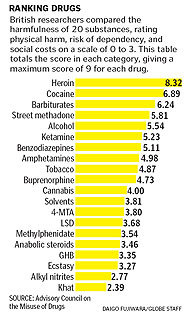 The Boston Globe offers a good summary of the recent U.K. row over drug classification:
In the long and tortured debate over drug policy, one of the strangest episodes has been playing out this fall in the United Kingdom, where the country’s top drug adviser was recently fired for publicly criticizing his own government’s drug laws....The list, printed as a chart with the unassuming title “Mean Harm Scores for 20 Substances,” ranked a set of common drugs, both legal and illegal, in order of their harmfulness - how addictive they were, how physically damaging, and how much they threatened society. Many drug specialists now consider it one of the most objective sources available on the actual harmfulness of different substances.
That ranking showed, with numbers, what Nutt was fired for saying out loud: Overall, alcohol is far worse than many illegal drugs. So is tobacco. Smoking pot is less harmful than drinking, and LSD is less damaging yet.
New federally financed drug research reveals a stark disparity: children covered by Medicaid are given powerful antipsychotic medicines at a rate four times higher than children whose parents have private insurance. And the Medicaid children are more likely to receive the drugs for less severe conditions than their middle-class counterparts, the data shows.
But the loss of his younger son, who overdosed on anti-anxiety medication and Scotch last year at age 30 while his older son was in residential treatment for alcoholism and cocaine addiction, changed his perspective.
“That’s why I took this job,” said Dr. McLellan, who was sworn in as the deputy director of the Office of National Drug Control Policy in August. “I thought it was some kind of sign, you know. I would never have done it. I loved all the people I’ve worked with, I loved my life. But I thought maybe there’s a way where what I know plus what I feel could make a difference.”
Married to a recovering cocaine addict, Dr. McLellan has been engulfed by addiction in life and work. His own family has been a personal battleground for one of the country’s most complex and entrenched problems, while as an expert he has been a leading voice for the idea that addiction is a chronic illness and not a moral issue.

Addiction Professional shines a light on Scott Kellogg and his Gradualism model. I've mentioned him several times in this blog and he has been kind enough to link to me on his website.
Two months ago Kellogg established a website (http://gradualismandaddiction.org) that he hopes will serve as a vehicle for discussion around a more nuanced approach to treatment. He says that after he began using the term “gradualism,” he noticed that practitioners in non-abstinence based initiatives in Europe in the 1970s had used the term “gradual change” to describe what they were trying to instill in persons with substance use problems.
A Gestalt-trained therapist, Kellogg holds some views that seem to place him closer to the harm reductionist’s way of looking at substance use and recovery. He questions treatment center practices that appear to profess abstinence at the risk of losing many clients before they can start making progress. He states his belief that “there’s a crisis in our treatment world because many people don’t like treatment.”
Yet he also says his perspective goes against the tenets held by many harm reductionists. He is most impatient with the attitude in some needle exchange programs and similar initiatives that “we would never tell people what to do.” Offering a shower, a sandwich and a clean needle and then repeating the process time and again are fine in the short term, but at some point you need to help build a life after you’ve saved one, he suggests.


In the emerging view, discussed in part at the Society for Neuroscience meeting last week in Chicago, dopamine is less about pleasure and reward than about drive and motivation, about figuring out what you have to do to survive and then doing it. “When you can’t breathe, and you’re gasping for air, would you call that pleasurable?” said Nora D. Volkow, a dopamine researcher and director of the National Institute on Drug Abuse. “Or when you’re so hungry that you eat something disgusting, is that pleasurable?”
In both responses, Dr. Volkow said, the gasping for oxygen and the wolfing down of something you would ordinarily spurn, the dopamine pathways of the brain are at full throttle. “The whole brain is of one mindset,” she said. “The intense drive to get you out of a state of deprivation and keep you alive.”
Dopamine is also part of the brain’s salience filter, its get-a-load-of-this device. “You can’t pay attention to everything, but you want to be adept as an organism at recognizing things that are novel,” Dr. Volkow said. “You might not notice a fly in the room, but if that fly was fluorescent, your dopamine cells would fire.”
In addition, our dopamine-driven salience detector will focus on familiar objects that we have imbued with high value, both positive and negative: objects we want and objects we fear. If we love chocolate, our dopamine neurons will most likely start to fire at the sight of a pert little chocolate bean lying on the counter. But if we fear cockroaches, those same neurons may fire even harder when we notice that the “bean” has six legs. The pleasurable taste of chocolate per se, however, or the anxiety of cockroach phobia, may well be the handiwork of other signaling molecules, like opiates or stress hormones. Dopamine simply makes a relevant object almost impossible to ignore.

Encouraging findings for people trying to quit smoking:
Placing this in the context of offering drug replacements to addicts is interesting food for thought. One important bit of context is that these were people who were trying to quit and the overarching goal of helping professionals with smokers is to try to help them quit, not reduce use. The nicotine addicts I know want full recovery. They want to be completely smoke free, and the few people I know who have been on nicotine replacement for years still really want to stop but can't. The system encourages their moves toward quitting completely and supports gradual change. That seems to be an important part of any lessons drawn from treatment for nicotine addiction. The focus of heroin maintenance is not to stabilize people while moving them toward quitting, it's to maintain them because we've concluded that they can't quit.Smokers are more than twice as likely to quit if they use the nicotine patch along with nicotine lozenges—compared to lozenges or patches alone, buproprion (Xyban), buproprion plus the lozenges or placebo. The trial was the largest study ever to compare these approaches head to head, and included 1,504 smokers.
All of the treatment groups did better than placebo—but the effect was strongest for the patch/lozenge combination, 40% of whom successfully kicked the habit. Smokers using this combo were not only more likely to quit, but also less likely to have a “slip” prompt a return to regular smoking.
The study adds support to a growing body of research that suggests that offering addicts access to drugs similar to their drug of choice—or even that drug itself—can actually help them quit or at least dramatically reduce the harm associated with their addiction.

holy cow, it’s happening to you too.Androcles writes a nice post on the infectious nature of recovery and hope.

1.1. Costs of Substance Abuse
Studies have shown the annual cost of substance abuse to the Nation to be $510.8 billion in 1999 (Harwood, 2000). More specifically,Substance abuse clearly is among the most costly health problems in the United States. Among national estimates of the costs of illness for 33 diseases and conditions, alcohol ranked second, tobacco ranked sixth, and drug disorders ranked seventh (National Institutes of Health [NIH], 2000). This report shows that programs designed to prevent substance abuse can reduce these costs.
- Alcohol abuse cost the Nation $191.6 billion;
- Tobacco use cost the Nation $167.8 billion;
- Drug abuse cost the Nation $151.4 billion.
1.2. Savings From Effective School-Based Substance Abuse Prevention
If effective prevention programs were implemented nationwide, substance abuse initiation would decline for 1.5 million youth and be delayed for 2 years on average. It has been well established that a delay in onset reduces subsequent problems later in life (Grant & Dawson, 1997; Lynskey et al., 2003). In 2003, an estimated:The average effective school-based program in 2002 costs $220 per pupil including materials and teacher training, and these programs could save an estimated $18 per $1 invested if implemented nationwide. Nationwide, full implementation of school-based effective programming in 2002 would have had the following fiscal impact:
- 5.6 percent fewer youth ages 13–15 would have engaged in drinking;
- 10.2 percent fewer youth would have used marijuana;
- 30.2 percent fewer youth would have used cocaine;
- 8.0 percent fewer youth would have smoked regularly.
Substance Abuse Prevention Dollars and Cents: A Cost-Benefit AnalysisAlthough 80 percent of American youth reported participation in school-based prevention in 2005 (SAMHSA, 2004), only 20 percent were exposed to effective prevention programs (Flewelling et al., 2005).
- Saved State and local governments $1.3 billion, including $1.05 billion in educational costs within 2 years;
- Reduced social costs of substance-abuse-related medical care, other resources, and lost productivity over a lifetime by an estimated $33.7 billion;
- Preserved the quality of life over a lifetime valued at $65 billion.

The suggestion that various non-punitive programs might control crime, and that doing so was preferable, ceteris paribus, to controlling crime by inflicting damage on offenders, met with an especially furious response, mostly centered on the phrase “liberal social engineering.” But the project of putting 1% of the adult population behind bars — an incarceration rate five times as high as any other advanced democracy, and five times as high as the U.S. ever had before 1975 — is itself a massive, massively risky, and expensive social-engineering project, and no less massive, risky, or expensive for never having been thought through. It also involves a completely unprecedented expansion of the power of the state over the individual.If all taxation is theft, then the $200 billion required to support the current policing, adjudication, and corrections systems is just as much “stolen” as the much smaller sums that might be usefully expended on improving parental performance by poor young first-time mothers, removing lead from the environment, or improving classroom discipline. If people who call themselves fiscal conservatives understood that a sentence of life without parole imposed on an 18-year-old represented a present-value expenditure of $1 million, the enthusiasm for “throwing away the key” might be diminished. (An execution, including the due process required — but not sufficient — to prevent the execution of the innocent, costs more.)
In my view, crime at current levels is such a social problem that even substantial increase in the $200 billion criminal-justice budget would be justified by even modest decreases in crime. If we can spend an extra $10 billion a year to have reduced crime and reduced incarceration, so much the better.
Now for the specifics:
1. Evidence about the capacity of nurse-family partnerships to reduce offending by more than 50% (based on a randomized controlled trial) is here.
2. Evidence about the impact of lead on crime takes two forms: individual-level studies, and econometric studies. The results are consistent, and the effect sizes are large. Moreover, the biology is understood: lead, even at low levels, damages cognitive function, and lower-level cognitive functioning reduces deterrability, thus increasing crime. Moreover, lead does specific damage to impulse control.
Therefore, lead causes crime, and removing lead reduces crime. It does so more cost-effectively than increasing incarceration, and it has side-benefits rather than side-costs.
3. I have no doubt that a minimum legal drinking age of 21 reduces drinking among minors, and that relaxing that rule would increase drinking (and drinking-related problems) in that population. It also generates massive disobedience and the mass acquisition of false ID. Increased alcohol taxes are effective in reducing drinking, and especially in reducing heavy, problem drinking (since an extra tax of a dime a drink wouldn’t much bother someone who averages a drink a day). The biggest impacts are on heavy drinking by minors, whose incomes tend to be limited. A combination of relaxing the age restriction and raising the price could reduce heavy drinking while avoiding the criminalization of mass behavior.


In Philadelphia in 2004, they decided to tackle the things that were wrong in their services. They did a giant exercise in information gathering, something they called a ‘fearless inventory’ after the AA fourth step. You can see the detail here:
They uncovered that some unhealthy stuff was going on. Organisations were not talking to each other. They existed like islands connected by drawbridges that ‘were permanently up’.
Focus groups uncovered “an underlying tone of paternalism, disrespect and, at times, outright contempt.”

IN THE 1980s, entire communities were devastated by the addiction and violence that accompanied crack, a smokable form of cocaine. Congress reacted by passing extraordinarily tough laws, including one that mandated a minimum prison sentence of five years for those in possession of as little as five grams of crack. Those arrested with 50 grams were automatically slapped with a 10-year sentence.
This supposed solution, backed at the time by many in the Congressional Black Caucus, turned out to be destructive also. Tens of thousands of black men -- many of them first-time offenders with no history of violent crime -- found themselves behind bars for inordinately long periods. White and Hispanic offenders -- those most often collared for powder cocaine violations -- had to be caught with 100 times the amount of powder to trigger the same mandatory minimum sentences.
. . .
smoking crack delivers a faster, more intense high than snorting powder and that this high is more short-lived, thus compelling most crack users to seek additional doses of the drug. The differences in addiction rates between crack and powder are not enormous, but they are real, and the study also notes that crack users often experience faster rates of physical deterioration than do those who consume powder. The report notes that roughly one-fourth of crack offenders are associated with violence, and that this rate exceeds that for powder cocaine offenders. As in the 1980s, predominantly African American communities continue to bear the brunt of the crime and addiction brought on by this awful drug.
These facts suggest that there should be some difference in the penalties for crack and powder cocaine, but how much? This is a difficult question to answer with precision, so perhaps the best solution would be to eliminate the mandatory minimums for both crack and powder and build into the sentencing guidelines tougher penalty ranges for crack that judges could apply on a case-by-case basis
The Economist magazine says this means that more than 200 million people -- almost 5 percent of the world's adult population -- take illegal drugs, the same proportion as a decade ago. The annual U.S. bill for attempting to diminish the supply of drugs is $40 billion. Of the 1.5 million Americans arrested each year on drug offenses, half a million are incarcerated. "[T]ougher drug laws are the main reason why one in five black American men spend some time behind bars," the Economist said in March.
"There is no correlation between the harshness of drug laws and the incidence of drug-taking: citizens living under tough regimes (notably America but also Britain) take more drugs, not fewer." Do cultural differences explain this? Evidently not: "Even in fairly similar countries tough rules make little difference to the number of addicts: harsh Sweden and more liberal Norway have precisely the same addiction rates."
The good news is the progress America has made against tobacco, which is more addictive than most illegal drugs. And then there is alcohol.
In "Waking Giant: America in the Age of Jackson," historian David S. Reynolds writes that in 1820, Americans spent on liquor a sum larger than the federal government's budget. By the mid-1820s, annual per capita consumption of absolute alcohol reached seven gallons, more than three times today's rate. "Most employers," Reynolds reports, "assumed that their workers needed strong drink for stimulation: a typical workday included two bells, one rung at 11 a.m. and the other at 4 p.m., that summoned employees for alcoholic drinks."
The elderly Walt Whitman said, "It is very hard for the present generation anyhow to understand the drinkingness of those years. . . . it is quite incommunicable." In 1842, a Springfield, Ill., teetotaler named Lincoln said that liquor was "like the Egyptian angel of death, commissioned to slay, if not the first, the fairest born in every family." Which helps explain why the nation sobered up (somewhat -- these things are relative). One reason crack cocaine use has declined is that a generation of inner-city young people saw what it did to their parents and older siblings.
Undoubtedly culture changes are critical to changing these behaviors, though it's my understanding that one reason for those high rates of alcohol consumption was that alcoholic beverages were often safer to drink than the available water.
I'd like to better understand how that culture change happened. Can it occur without heavy moralizing and the formation of temperance societies? It would seem that this culture change eventually culminated in prohibition. Clearly not what George Will has in mind.
Junk food elicits addictive behavior in rats similar to the behaviors of rats addicted to heroin, a new study finds. Pleasure centers in the brains of rats addicted to high-fat, high-calorie diets became less responsive as the binging wore on, making the rats consume more and more food. The results, presented October 20 at the Society for Neuroscience’s annual meeting, may help explain the changes in the brain that lead people to overeat.
“This is the most complete evidence to date that suggests obesity and drug addiction have common neurobiological underpinnings,” says study coauthor Paul Johnson of the Scripps Research Institute in Jupiter, Fla.
The new mayor, Dan Sullivan, a Republican, has created a staff position and a task force devoted to addressing homelessness. The police recently gained the authority to dismantle homeless encampments with just 12 hours’ notice. Citizen groups are patrolling parks where homeless camps have been the site of rapes and other violence. But in perhaps the biggest and most controversial break from how the city has handled the problem in the past, a Salvation Army detoxification and alcohol abuse treatment center has begun accepting chronic inebriates who have been taken there essentially by force.There is also a video about the story here.
With $1.2 million in new state financing pushed through by one of Alaska’s more liberal Democrats, State Senator Johnny Ellis of Anchorage, the facility, the Clitheroe Center, is accepting people committed under a state law, Title 47. Under the law, a judge can order people into secure treatment for 30 days, and potentially for months, if the police, a doctor or family members convince the judge that the person’s abuse of alcohol has made them a threat to themselves and others. The person does not need to have committed a crime.
“Ten years ago, there would have been a community outcry that Johnny Ellis is locking up people with the disease of addiction,” Mr. Ellis said. “ ‘How can he do that and say he’s still a progressive?’ ”
Now, Mr. Ellis said, the problem has increased so much “that for various motivations people are saying let’s try something new.” He added, “The people dropping dead during the summertime really got this community paying attention.”
One homeless person drowned. Another was hit by a car. One died from hypothermia. Most had been drinking, and several had four or even five times the blood-alcohol level above which a person is considered too drunk to drive. Experts say the problem of public drunkenness is part of a larger homeless problem that disproportionately affects Native Alaskans, particularly men who have moved in from rural parts of Alaska and lost their way in the city. The recession has also played a role.
Involuntary commitment of homeless alcoholics has been used elsewhere in the country. Some homeless advocates say it infringes on civil rights, and they question its effectiveness. Here in Anchorage, several longtime advocates said the severity of the situation had made them open to giving it a chance.


A study that will appear in the December issue of the American Journal of Public Health tracked the ways in which party affiliation related to people's responses to identical information on diabetes.
Participants in the study read a mock news article on the American Diabetes Association lobbying Congress for greater attention to Type 2 diabetes, the sixth-leading cause of death in the United States. Some people read a straight news report, with minimal mention of what causes diabetes. Others read one of three versions of the story: one that pegged the disease primarily to genetic factors; one that emphasized personal choices; and one that focused on social and environmental factors, such as access to safe places to exercise and affordable, healthy food.
The study's authors, University of Pennsylvania researcher Sarah E. Gollust, along with the University of Michigan's Paula M. Lantz and Peter A. Ubel, were most interested in how people responded to the notion that "social determinants" -- how easy it is to buy fresh vegetables or exercise, among other things -- are underlying causes of disease. Public health advocates have been promoting the importance of these factors, believing that the more people know about these circumstances, the more likely they are to want to help.
But that assumption doesn't hold up. When people who identified themselves as Democrats read specifically about the social factors that can lead to Type 2 diabetes, they expressed greater backing for public health policies aimed at addressing those factors; Republicans, by contrast, registered much lower levels of support.
"The take-home message is that people can walk away from the same information with different attitudes," Gollust says.

Project Prevention makes sense to me. Although a few thousand IUDs might not make a dent in the problem, the bluntness of the gesture turns up the volume.It doesn't "make a dent in the problem" but it "turns up the volume." Turns up the volume of what exactly? Bringing them "in on the dialogue"? Who's dialogue? "Helping mothers heal" by encouraging sterilization?
And it brings drug-using moms in on the dialogue. Thank you for helping me do the first responsible thing I've ever done with my addiction, one mother wrote in a letter to Harris, who solicits a life story from every client.
"They're not bad women," Harris told me. "They don't set out to have babies that are taken away. They feel regret about what they've done."
She's right. Demonizing the mothers doesn't help. They need counseling, not just contraception. Many were victims of childhood trauma and are prisoners of addiction now.
Some hope giving birth will redeem and stabilize their lives. "It's one of the few things they can do that they have control over," said retired social worker Glynis Morrow. "Then the realities of parenting hit. And they feel like failures. And that pain drives them back to drugs."
And we're right back where we started from.
So we can talk about women's rights or about the privilege of procreation. However we cast the conversation, there is one truth we can't avoid: We are helping mothers heal when we keep unwanted children from being born.

The 2009 Annual Report of the Office of Substance Abuse Treatment Services (OSATS), formerly the Division of Addiction and Recovery Services, includes return-to-custody data on offenders who paroled in Fiscal Year 2005-06 for a one-year and a two-year period. The return to custody rate after one year for offenders completing both in-prison and community-based treatment in FY 2005-06 was 21.9 percent compared to 39.9 percent for all offenders. The return to custody rate after two years for offenders completing both in-prison and community-based treatment in FY 2005-06 was 35.3 percent compared to 54.2 percent for all offenders.
For male offenders, the return-to-custody rate after one year for those who completed both in-prison and community-based substance abuse treatment in FY 2005-06 was 25.4 percent compared to 41.2 percent of all male offenders. The return-to-prison rate after two years for male offenders who completed both in-prison and community-based substance abuse treatment in FY 2005-06 was 40.4 percent compared to 55.6 percent of all male offenders.
Female offenders were especially responsive to substance abuse treatment. After one year, only 8.8 percent of female offenders who completed both in-prison and community-based substance abuse treatment in FY 2005-06 were returned to custody compared to 30.1 percent of all female offenders. The return-to-prison rate after two years for female offenders who completed both in-prison and community-based substance abuse treatment in FY 2005-06 was 16.5 percent compared to 43.7 percent of all female offenders.


For many students, moving to Ann Arbor to begin their careers at the University of Michigan is a time of excitement, curiosity and maybe a little bit of fear. But for School of Social Work graduate student Ivana Grahovac, the emotions were different.Read the rest here.
As Grahovac prepared to start her time at the University, she was also recovering from a five-year addiction to heroin. Though she had been clean and sober for four-and-a-half years in her hometown of Bloomfield Hills, Mich., she wasn’t sure she could recreate that security in Ann Arbor.
Grahovac said coming to Ann Arbor was a “leap of faith” and that once she arrived, she felt her sobriety constantly threatened.
“I was constantly getting these e-mails about being invited to join people for keggers, drink night specials and pub-crawls,” she said. “There was just a real lack of understanding going on that maybe there are people for whom this would be a very bad choice and possibly cause some serious negative and tragic consequences to occur.”
It was in this environment that Grahovac decided to create Students for Recovery, a group aiming to support and provide provides information for students recovering from addiction. The group also helps students find sober programming as an alternative to the usual Friday night party filled with red Solo cups and alcohol.

I am completely in favour of helping people who use drugs to stop, if that is what they want. I assume that is what is meant by ‘recovery’. Working with anyone who has problems with drugs must start where the individual is and could involve a range of strategies. Harm reduction should permeate the services available to drug users, which should be used on the basis of evidence of effectiveness, including cost-effectiveness, and on the basis of allocating scarce resources in the most effective way on a population base.I wonder about the evidence for his first statement. How many people has he or his organization helped achieve drug-free recovery? How many of the people they serve want drug-free recovery, and how many people can't access services to achieve this goal? Do they track this information? Do they use it to advocate for more drug-free treatment services?
The recovery agenda is a dishonest political agenda, by which some treatment agencies are positioning themselves for a seamless transition to a Conservative government. It ignores evidence and relies on faith. It is becoming evangelistic. It is dishonest because it is completely undeliverable financially and it raises false hopes. It is not a public health approach.Whoa! I'm not there to see for myself, so I don't know if the U.K. recovery movement is a cabal of political conservatives or ideologues trying to exploit political conservatives. I see no political pandering on Wired in.
The basis of drugs work should always be harm reduction. It should always be public health-based and if it helps with public order that is fine with me.Why is drug-free treatment incompatible with public health? I think it is, but it's also important to keep in mind some of the limitations of public health models--tension between prevention and treatment is common in these arguments, Public health approaches always include the application of some values (even when we say they don't), and they risk turning life and death decisions for entire classes of people into cold accounting exercises. For example, why do we cringe at a harm reduction/public health approach to female circumcision? (More here and here.)


Many people would argue that the UK treatment system, in main, is simply managing symptoms and accepting long-term disability or discomfort of people with serious substance use problems.
These same people would not argue against the value of treatment per se, rather it needs to be provided in a different way.
The recovery movement is first and foremost a civil rights movement. It is about helping disadvantaged people, people with problems, improve their well-being.
It is about helping people with substance use problems (and often many other problems) reclaiming or claiming their right to a safe, dignified, meaningful and gratifying life in the community, sometimes despite their problems.
A recovery oriented system of care places the person with the problem at the centre of the system. It does not just build places where people go and get ‘treatment’ – it builds forms of support theroughout the community.
It accepts that the struggles of the person are not just with what is going on within their own body and mind – it is about their social struggles, which they experience because of the prejudice, discrimination, stigma and marginalisation that occurs in society.

Based on the consistency of findings across the studies, the confounders controlled for, the dose response relationships, as well as the theoretical plausibility and experimental findings regarding the impact of media exposure and commercial communications, it can be concluded from the studies reviewed that alcohol marketing increases the likelihood that adolescents will start to use alcohol, and to drink more if they are already using alcohol.

The problem with the methadone community is we have too many people who think methadone is a magic bullet for that disease—that recovery involves nothing more than taking methadone.He bemoans the lack of recovery-oriented providers:
This view is reinforced by people who, with the best of intentions, proclaim, “Methadone is recovery.” Methadone is not recovery. Recovery is recovery. Methadone is a pathway, a road, a tool. Recovery is a life and a particular way of living your life. Saying that methadone is recovery let’s people think that, “Hey, you go up to the counter there, and you drink a cup of medication, and that’s it. You’re in recovery.” And of course, that’s nonsense. Too many people in the methadone field learn that opiate dependence is a brain disorder, and they think that that’s all there is to it. But just like any other chronic medical condition, it has a behavioral component that involves how you live your life and the daily decisions you make.
Bill: Do you see the methadone clinics in the United States developing more recovery-oriented philosophies in their service practices?This will be a very interesting movement to watch. Read the rest here.
Walter: I wish I could say I did, but it’s a yes and no. I’ve been to all the AATOD conferences since 2001 and there are clearly people who are developing more recovery-oriented programs, but there are 1200 methadone programs in the U.S. How many are represented at the AATOD? 40? So yes, some of the programs are developing more recovery-oriented services, but many are not.


